
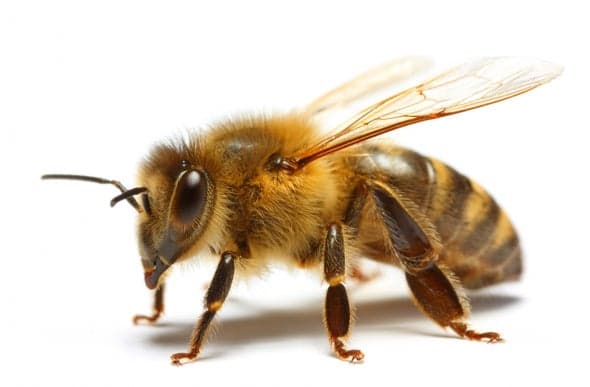
The bee has been declared the most important living being on the planet
According to the conclusions of the Earthwatch Institute, which were presented at the latest meeting of the Royal Geographical Society of London, bees are the most important species on the planet.
The scientists, however, also reached another conclusion: bees are already in a state of danger of extinction.
According to recent studies, bees have declined by 90%.
The reasons are many and vary according to the region, but among the most important are: the mass deforestation of forests, the lack of safe places for nests, the lack of flowers, the uncontrolled use of pesticides and changes in the soil.
Why are bees considered the most important species on the planet?
The Beekeeping Business Centre of Mayor University and the Beekeeping Association of Chile carried out a study in which they demonstrated that bees are the only living being that does not carry any type of pathogen, fungus, virus or bacterium.
The agricultural world depends 70% on these insects. Seventy per cent of the foods that are produced are related in some way to bees.
Also, the pollination performed by bees allows the reproduction of the plants on which millions of animals feed. Without them, the fauna would soon begin to disappear. Finally, the honey produced by bees not only serves as food, but offers many benefits for our health and skin.
According to an estimate by Albert Einstein, “if bees disappear, humans have four years of life left”.
Why are they in danger?
According to the Swiss Federal Institute of Technology, one reason bees are in danger is the waves produced by mobile telephone technology. According to the Institute’s scientists, the waves produced during calls are capable of disorienting bees and putting their lives in danger.
The researcher Daniel Favre and his colleagues carried out 83 experiments which proved that in the presence of these waves, bees produce a noise ten times greater than normal — behaviour that does not go unnoticed by other bees either: they are in danger and must abandon their hive.
Undoubtedly, the most important reason that threatens them is the continuous pesticide spraying of crops. A characteristic example is what is happening in Colombia, where over the last three years 34% of bees have died from poisoning.
Is there a solution to the problem?
There are solutions. The problem is that they are very difficult to implement, because there are very entrenched practices in the field of production and agriculture. Nevertheless, three solutions are proposed in the hope that they can be realised in the short term:
Banning, not merely reducing, the use of toxic pesticides.
Promoting completely natural agricultural alternatives.
Continuous research and monitoring of the health, well-being and conservation of bees.
“It is vital to establish the strategic nature of the protection and reproduction of bees and other pollinators. If this is not done, in ten years there will be no bees in Colombia. This will lead to a food catastrophe and a health crisis in the country,” was the message of Luciano Grisales, a representative of the country’s Chamber of Commerce.
The article was published in Physics and Astronomy Zone on 4 July 2019 and was translated by Pass world.