
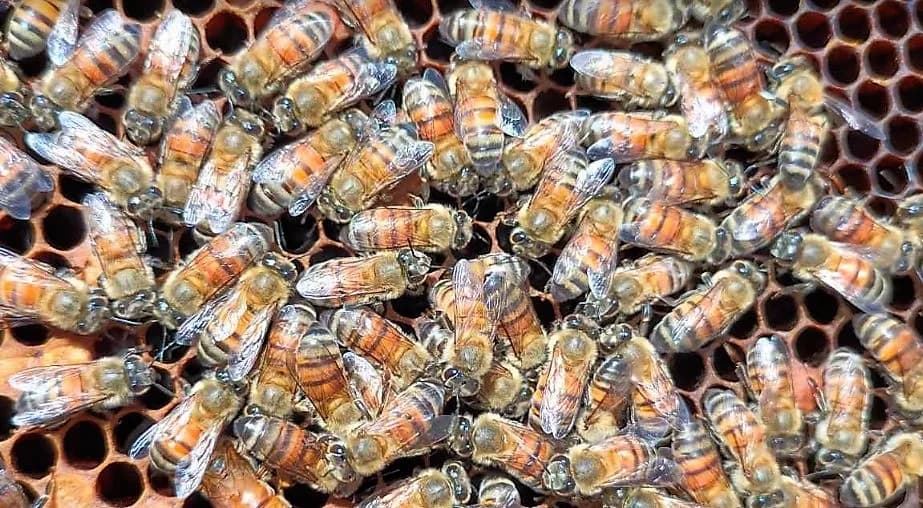
The queen bee
Bees are part of the insect kingdom. They display a strict hierarchy and live as families in hives. The queen bee is the “leader” of each family, and her goal is to ensure the reproduction of the species.
In addition, the family also has a few male bees, known as drones. The drones, who make up a small part of the family, have as their goal to fertilise the queen once. This is because after the act, they die.
Each bee family, also known as a colony, contains thousands of female bees. Most of them often cannot lay eggs, yet they make up an important part of the population and are considered worker bees. Part of their work also includes:
- creating a food store,
- gathering food and pollen,
- keeping each hive clean and guarding it,
- caring for the larvae, and
- tending to the queen.
Specifically, once the queen has been fertilised, she is surrounded by worker bees who tend to her in such a way that they take on her scent and carry it throughout the entire hive, so that the presence and dominance of the queen becomes evident.
How long does the queen bee live?
She lives up to 5 years, and this is a result of her rich diet of royal jelly. By contrast, the other worker bees, which feed only on honey, live at most up to 6 months.
Size of the queen bee
The queen is the largest in body of all the bees in the hive. However, when it comes to width, the body of the drones is larger. The span of her wings is shorter than the rest of her body’s length. This is why, from a distance, she often looks like a wasp.
How many eggs does the queen bee lay?
The greatest purpose of the queen in bee society is reproduction. She lays up to 2000 eggs a day. In other words, an egg is produced every six seconds, and together they weigh seven times more than the queen herself!
The laying of eggs depends on various aspects, such as the season or the quality of the food available in the nest. To carry out egg-laying, the queen feeds on the royal jelly that the bees give her as food.
What kind of eggs does the queen bee lay?
She lays two kinds of eggs. Fertilised and unfertilised. Those that have not been fertilised will later become drones, whereas the fertilised ones will become female bees. This is how “sex differentiation” takes place. Then, the female bees may become either queens or workers, which depends on the type of their diet during the stage of their larval age.
The larvae that rise to become queens feed, almost exclusively, on royal jelly, every day throughout their lives. On the other hand, the larvae that become workers eat a little royal jelly during the first three days and, for the rest, pollen and honey. And so unfolds what is called “caste differentiation”.
The queen bee with a sting that… kills
Her sting is used only when she wishes to kill. Specifically, the queen’s sisters or another queen, because they represent competition, and it is almost never used against a human. At this point it is worth noting that, in general, bees do not sting without a reason!
The difference between a worker with a sting and a queen with a sting
For the worker bee, its sting is its defence. That is, when it feels that its life or the hive to which it belongs is threatened, it stings. As it struggles to escape from the spot where it drove in its sting, because it gets stuck, it is not able to pull its sting out. This happens because, in extracting the sting, it simultaneously leaves behind the barbs, the glands with the venom, and the entire sting apparatus. The injection of the venom can last from 30 to 60 seconds. After a little while, its death follows. By contrast, when it comes to the queen and her sting, the maximum production of venom occurs when she emerges from the royal cell and just before the battle for her “dominance” against the other queens begins.
It could be said that the queen bee is the life-giving source within the hive. That is, she constitutes an important and inseparable part of bee society, but she does not decide everything on her own. Sometimes the entire bee society decides collectively, keeping in mind the interest of the swarm and not that of the queen! More information about the queen bee, as well as about the species of bees, you can find here.